

Health Library
Ebstein anomaly
Ebstein's anomaly; Ebstein's malformation; Congenital heart defect - Ebstein; Birth defect heart - Ebstein; Cyanotic heart disease - Ebstein
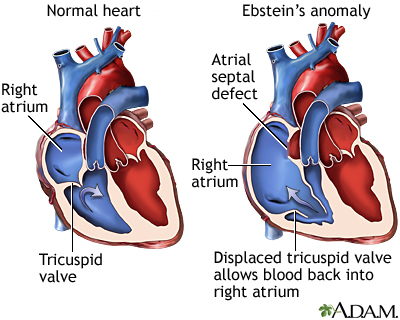
Ebstein anomaly is a rare heart defect in which parts of the tricuspid valve are abnormal. The tricuspid valve separates the right lower heart chamber (right ventricle) from the right upper heart chamber (right atrium). In people with Ebstein anomaly, the positioning of the tricuspid valve and how it functions to separate the two chambers is abnormal.
The condition is congenital, which means it is present at birth.
Images
I Would Like to Learn About:
Causes
The tricuspid valve is normally made of three parts, called leaflets or flaps. The leaflets open to allow blood to move from the right atrium (top chamber) to the right ventricle (bottom chamber) while the heart relaxes. They close to prevent blood from moving from the right ventricle to the right atrium while the heart pumps.
In people with Ebstein anomaly, the leaflets are placed deeper into the right ventricle instead of the normal position. The leaflets are often larger than normal. The defect most often causes the valve to work poorly, and blood may go the wrong way. Instead of flowing out to the lungs, the blood flows back into the right atrium. The backup of blood flow can lead to heart enlargement and fluid buildup in the body. There may also be narrowing of the valve that leads to the lungs (pulmonary valve).
In many cases, people also have a hole in the wall separating the heart's two upper chambers (atrial septal defect) and blood flow across this hole may cause oxygen-poor blood to go to the body. This can cause cyanosis, a blue tint to the skin caused by oxygen-poor blood.
Ebstein anomaly occurs as a baby develops in the womb. The exact cause is unknown. The use of certain drugs (such as lithium or benzodiazepines) during pregnancy may play a role. The condition is rare. It is more common in white people.
Symptoms
The abnormality can be slight or very severe. Therefore, the symptoms can also range from mild to very severe. Symptoms can develop soon after birth, and can include bluish-colored lips and nails due to low blood oxygen levels. In severe cases, the baby appears very sick and has trouble breathing. In mild cases, the affected person may be asymptomatic for many years, sometimes even permanently.
Symptoms in older children may include:
- Cough
- Failure to grow
- Fatigue
- Rapid breathing
- Shortness of breath
- Very fast heartbeat
About 5% to 25% of people with Ebstein anomaly also have Wolff-Parkinson-White (WPW) syndrome. WPW causes heart palpitations, dizziness, and chest tightness.
Exams and Tests
The health care provider may hear abnormal heart sounds, such as a murmur, when listening to the chest with a stethoscope.
Tests that can help diagnose this condition include:
- Chest x-ray
- Magnetic resonance imaging (MRI) of the heart
- Measurement of the electrical activity of the heart (electrocardiogram or ECG)
- Ultrasound of the heart (echocardiogram)
Treatment
The treatment depends on the severity of the defect and the specific symptoms. Medical care may include:
- Medicines to help with heart failure, such as diuretics.
- Oxygen and other breathing support.
- Surgery to correct the valve.
- Replacement of the tricuspid valve. This may be needed for children who continue to worsen or who have more serious complications.
Outlook (Prognosis)
In general, the earlier symptoms develop, the more severe the disease.
Some people may have either no symptoms or very mild symptoms. Others may worsen over time, developing blue coloring (cyanosis), heart failure, heart block, or dangerous heart rhythms.
Possible Complications
A severe leakage can lead to swelling of the heart and liver, and congestive heart failure.
Other complications may include:
- Abnormal heart rhythms (arrhythmias), including abnormally fast rhythms (tachyarrhythmias) and abnormally slow rhythms (bradyarrhythmias and heart block)
- Blood clots from the heart to other parts of the body
- Brain abscess
When to Contact a Medical Professional
Contact your provider if your child develops symptoms of this condition. Get medical attention right away if breathing problems occur.
Prevention
There is no known prevention, other than talking with your provider before a pregnancy if you are taking medicines that are thought to be related to developing this disease. You may be able to prevent some of the complications of the disease. For example, taking antibiotics before dental surgery may help prevent endocarditis.
References
Bernstein D. General principles of treatment of congenital heart disease. In: Kliegman RM, St. Geme JW, Blum NJ, et al, eds. Nelson Textbook of Pediatrics. 22nd ed. Philadelphia, PA: Elsevier; 2025:chap 483.
Gurvitz M, Krieger EV, Fuller S, et al. 2025 ACC/AHA/HRS/ISACHD/SCAI Guideline for the Management of Adults With Congenital Heart Disease: A Report of the American College of Cardiology/American Heart Association Joint Committee on Clinical Practice Guidelines. J Am Coll Cardiol. 2026;87(7):822-976. PMID: 41411480 pubmed.ncbi.nlm.nih.gov/41411480/.
Kliegman RM, St. Geme JW, Blum NJ, et al. Cyanotic congenital heart disease: lesions associated with decreased pulmonary blood flow. In: Kliegman RM, St.Geme JW, Blum NJ, et al, eds. Nelson Textbook of Pediatrics. 22nd ed. Philadelphia, PA: Elsevier; 2025:chap 480.
Krieger EV, Dorfman AL, Babu-Narayan SV, Valente AM. Congenital heart disease in the adolescent and adult. In: Bonow RO, Mann DL, Tomaselli GF, et al, eds. Braunwald's Heart Disease: A Textbook of Cardiovascular Medicine. 13th ed. Philadelphia, PA: Elsevier; 2026:chap 87.
Therrien J, Marelli AJ. Congenital heart disease in adults. In: Goldman L, Cooney KA, eds. Goldman-Cecil Medicine. 27th ed. Philadelphia, PA: Elsevier; 2024:chap 55.
Well A, Fraser CD. Congenital heart disease. In: Tyler DS, Hayes-Dixon A, Hines OJ, et al, eds. Sabiston Textbook of Surgery: The Biological Basis of Modern Surgical Practice. 22nd ed. Philadelphia, PA: Elsevier; 2026:chap 113.
BACK TO TOPReview Date: 2/9/2026
Reviewed By: Michael A. Chen, MD, PhD, Associate Professor of Medicine, Division of Cardiology, Harborview Medical Center, University of Washington Medical School, Seattle, WA. Also reviewed by David C. Dugdale, MD, Medical Director, Brenda Conaway, Editorial Director, and the A.D.A.M. Editorial team.
 | A.D.A.M., Inc. is accredited by URAC, for Health Content Provider (www.urac.org). URAC's accreditation program is an independent audit to verify that A.D.A.M. follows rigorous standards of quality and accountability. A.D.A.M. is among the first to achieve this important distinction for online health information and services. Learn more about A.D.A.M.'s editorial policy, editorial process and privacy policy. A.D.A.M. is also a founding member of Hi-Ethics. This site complies with the HONcode standard for trustworthy health information: verify here. |
The information provided herein should not be used during any medical emergency or for the diagnosis or treatment of any medical condition. A licensed medical professional should be consulted for diagnosis and treatment of any and all medical conditions. Links to other sites are provided for information only -- they do not constitute endorsements of those other sites. No warranty of any kind, either expressed or implied, is made as to the accuracy, reliability, timeliness, or correctness of any translations made by a third-party service of the information provided herein into any other language.
© 1997-
2026 A.D.A.M., a business unit of Ebix, Inc. Any duplication or distribution of the information contained herein is strictly prohibited.
All content on this site including text, images, graphics, audio, video, data, metadata, and compilations is protected by copyright and other intellectual property laws. You may view the content for personal, noncommercial use. Any other use requires prior written consent from Ebix. You may not copy, reproduce, distribute, transmit, display, publish, reverse-engineer, adapt, modify, store beyond ordinary browser caching, index, mine, scrape, or create derivative works from this content. You may not use automated tools to access or extract content, including to create embeddings, vectors, datasets, or indexes for retrieval systems. Use of any content for training, fine-tuning, calibrating, testing, evaluating, or improving AI systems of any kind is prohibited without express written consent. This includes large language models, machine learning models, neural networks, generative systems, retrieval-augmented systems, and any software that ingests content to produce outputs. Any unauthorized use of the content including AI-related use is a violation of our rights and may result in legal action, damages, and statutory penalties to the fullest extent permitted by law. Ebix reserves the right to enforce its rights through legal, technological, and contractual measures.
